URANIUM Active Exploration

Mkuju Corridor Uranium Project

Ruvuma Karoo Basin Block A, Tanzania

A 1,328 km² uranium exploration portfolio of five prospecting licences in Tanzania's Ruvuma Karoo Basin — sitting directly adjacent to the world-class Nyota deposit (156.6 Mlbs U₃O₈) and hosting SWC-Mtonya: a 12 km radiometric anomaly with trench assays to 7,139 ppm U₃O₈.

1,328km²
Portfolio Area
5
Prospecting Licences
12km
Anomaly Length
7,139ppm U₃O₈
Peak Trench Assay
Overview

The Mkuju Corridor Uranium Project is a 1,328 km² exploration portfolio comprising five prospecting licences in the Block A uranium corridor of the Ruvuma Karoo Basin, southern Tanzania. The licences sit immediately adjacent to the Nyota uranium deposit — hosting 156.6 Mlbs of adjusted U₃O₈ — and the Likuyu North deposit, both controlled by established international uranium developers.

The flagship prospect within the corridor is SWC-Mtonya, where a 12-kilometre radiometric anomaly has been delineated from regional airborne coverage. Historical auger results returned up to 3,825 ppm U₃O₈, and AURX's recent trench programme returned peak assays of 7,139 ppm U₃O₈ — grades that place SWC-Mtonya among the highest-grade surface uranium intercepts reported anywhere in the Karoo uranium province.
Location & Tenure
Total Area1,328 km² across 5 prospecting licences
RegionRuvuma Region, southern Tanzania
BasinRuvuma Karoo Basin, Block A
Adjacent DepositsNyota (156.6 Mlbs U₃O₈ adjusted), Likuyu North
Priority ProspectSWC-Mtonya (12 km radiometric anomaly)
AccessAll-season road access from Songea
Geological Setting

The Mkuju uranium province is a classic Karoo-age sedimentary roll-front system. Host stratigraphy comprises fluvio-lacustrine sandstones, siltstones and carbonaceous mudstones of the Karoo Supergroup, deposited in intracontinental rift basins during the Permo-Triassic. Uranium was mobilised from overlying granitoid source terrains by meteoric groundwater, transported in oxidised form, and precipitated at redox fronts where reducing conditions — typically organic carbon or sulphide — arrested the flow.

Mineralisation at Nyota and Likuyu North occurs as tabular, flat-lying bodies in palaeochannel sandstones. The same redox-front architecture extends across AURX's licence package, with the SWC-Mtonya anomaly interpreted as a continuation of the principal mineralised trend. The roll-front style is amenable to in-situ recovery (ISR) extraction, the lowest-cost and lowest-footprint uranium mining method currently deployed globally.

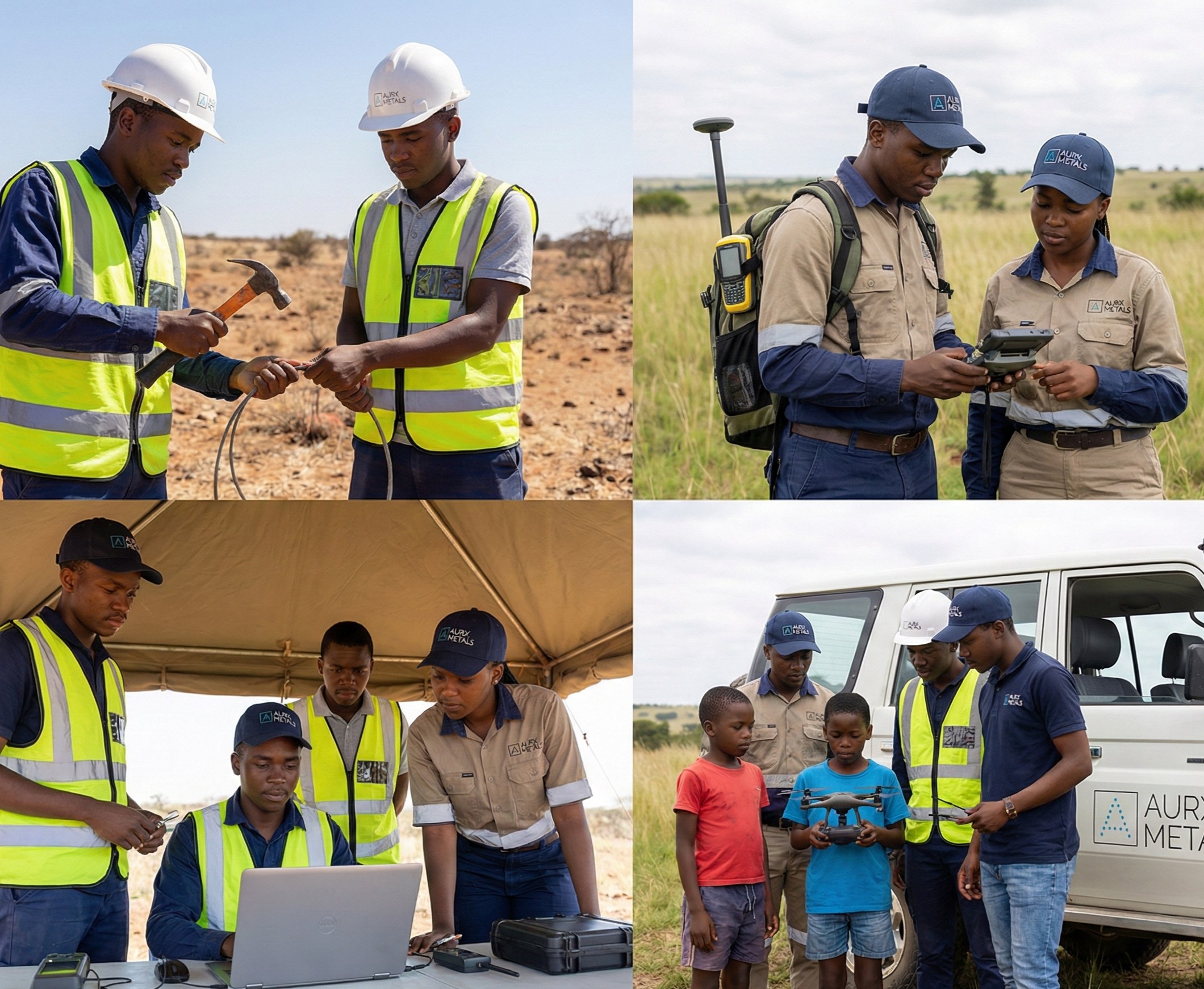
AURX field teams have completed radiometric mapping and trench sampling across the priority SWC-Mtonya anomaly.

Exploration Rationale

The project benefits from three reinforcing technical pillars. First, a proven regional endowment — Nyota's 156.6 Mlbs of contained uranium demonstrates that the Mkuju corridor hosts economically significant deposits. Second, a delineated 12-kilometre radiometric anomaly with peak trench assays to 7,139 ppm U₃O₈, comparable to or exceeding grades reported from the adjacent producing deposits. Third, a mineralisation style well-suited to modern low-cost ISR extraction.

Into this technical thesis, macroeconomic tailwinds — nuclear's re-emergence as the only baseload carbon-free source at scale, combined with record AI infrastructure power demand — have produced a structural uranium supply gap. The Mkuju Corridor is positioned at the intersection of all of these forces.

Work Completed
  • Regional airborne radiometric and magnetic interpretation across all five licences
  • 12-kilometre anomaly delineation at SWC-Mtonya from radiometric data
  • Trench programme returning peak assays to 7,139 ppm U₃O₈ at surface
  • Integration of historical auger geochemistry (peak 3,825 ppm U₃O₈) into a single structured database
  • Baseline environmental and social scoping across the priority tenements
Forward Programme

The next programme phase comprises detailed ground-radiometric follow-up across the remaining 9 km of the SWC-Mtonya anomaly not yet trenched; a maiden RC drill campaign of approximately 3,000 metres, targeting the trench intersections at depth to confirm roll-front geometry; auger and infill soil geochemistry on secondary targets across the broader 1,328 km² package; and initial scoping of ISR amenability (hydrogeology, aquifer characterisation, leachability testing) to support eventual development-track decisions.

Exploration Target
Total Licence Area1,328 km² (5 PLs)
Priority Anomaly Length12 km (SWC-Mtonya)
Peak Trench Assay7,139 ppm U₃O₈
Peak Historical Auger3,825 ppm U₃O₈
Adjacent Resource (Nyota)156.6 Mlbs U₃O₈ (geological context only)

References to adjacent deposits (Nyota, Likuyu North) are for geological context only and do not imply any economic association with AURX Metals. The exploration target described above is conceptual in nature.

Competent Person & Forward-Looking Statements

The exploration information and conceptual exploration targets described on this page have been compiled under the supervision of AURX Metals' in-house geological team. Conceptual exploration targets are not Mineral Resources. The potential quantity and grade referred to is conceptual in nature; there has been insufficient exploration to estimate a Mineral Resource and it is uncertain whether further exploration will result in the estimation of a Mineral Resource. References to adjacent deposits are for geological context only and do not imply any economic association with AURX Metals. Forward-looking statements are subject to risks and uncertainties — readers should not place undue reliance on them.